10 Rack Oven Buying Tips for Global Buyers

Buying a rack oven is not simply a choice between gas and electricity. It is a production decision that affects consistency, labor, energy use, and customer trust.

Jeffrey Hamelman, a respected baker, author, and former director at King Arthur Baking Company, often emphasizes a practical truth: “The oven should support the baker, not fight the baker.” That principle matters when comparing rack oven models across different markets. A spacious chamber may look impressive, yet poor airflow can leave the front tray golden and the rear tray pale. Small details matter.

Global buyers must examine capacity, rack dimensions, steam performance, heat recovery, controls, insulation, and cleaning access. Local voltage and fuel availability also deserve careful checking. A model suitable for a European bakery may require different specifications in Southeast Asia or North America. Service coverage can be even more important than the purchase price. A low-cost oven becomes expensive when a replacement fan waits six weeks at a port.

Look closely.

Ask suppliers for test-bake evidence, not polished photographs. Request temperature maps, energy data, warranty terms, and spare-parts support. Consider the products you actually bake, from crusty bread to delicate pastries. Their moisture levels and loading patterns may expose weaknesses quickly.

This guide is practical, but not perfect. Buying decisions involve compromises. The right rack oven may still demand operator training, recipe adjustments, and disciplined maintenance. Careful questions now can prevent uneven loaves, wasted batches, and uncomfortable surprises after installation.
10 Rack Oven Buying Tips for Global Buyers

What a Rack Oven Is and How It Supports High-Volume Baking

10 Rack Oven Buying Tips for Global Buyers

What a Rack Oven Is and How It Supports High-Volume Baking

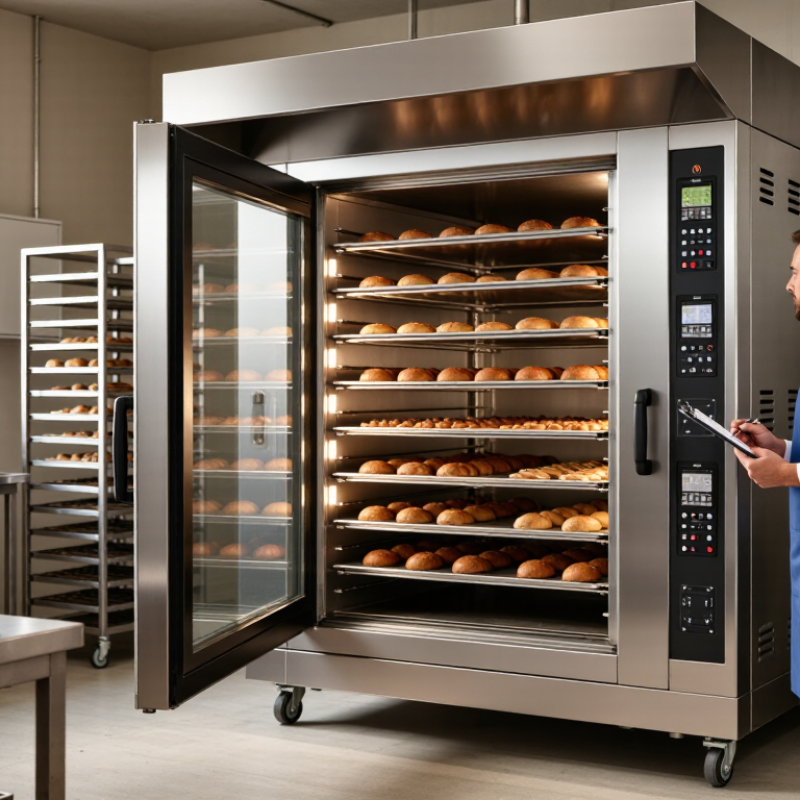
A rack oven is an insulated chamber designed to bake full wheeled racks of products. It combines controlled heat, airflow, and steam inside one enclosure. This format reduces tray handling between loading and unloading. Volume is the point.

For bakeries producing bread, rolls, pastries, or frozen dough, rack ovens support repeatable batch cycles. Operators can load several trays at once, then adjust temperature, steam, fan speed, and baking time. The FAO Food Outlook 2024 forecast global wheat production at approximately 789 million tonnes. That scale reflects continuing pressure on commercial baking capacity.

Energy deserves careful attention. The U.S. Department of Energy reports that process heating represents about 51% of manufacturing energy use. Oven efficiency can therefore influence operating costs significantly. Check insulation, heat recovery options, burner performance, and standby consumption. Do not rely on brochure capacity alone.

Measure the rack footprint first. Confirm door clearance, ceiling height, floor strength, and ventilation needs. Compare actual output per hour, not only chamber size. Ask for test-bake records using your dough, tray spacing, and target crust. Steam recovery may be imperfect. Condensation can create maintenance problems. Controls should support local voltage, language, safety rules, and technician access. A smaller oven with stable recovery may outperform a larger one in daily production.

How to Match Oven Capacity, Rack Size, and Production Requirements

Matching a rack oven to production needs starts with real output, not the largest advertised capacity. Count the trays used per batch, product weight, baking time, and daily demand. Then estimate hourly output with this formula: trays per rack × racks × batches per hour. Reduce the result for loading, unloading, temperature recovery, and cleaning. That adjustment matters.

Rack size must fit your actual trays, not a convenient catalog dimension. Measure tray length, width, height, and handle clearance. Check the rack turning path through every doorway. A rack may fit inside the oven but fail at the entrance. Leave working space around the door and service panels. Confirm floor strength, ventilation, electrical supply, or fuel requirements with qualified local professionals.

Do not ignore product behavior. Bread, pastries, and prepared meals can need different airflow, humidity, and temperature recovery. A fully loaded rack may bake unevenly if the fan cannot circulate air properly. Ask for test baking with your own trays and recipes. Request production data under realistic loading conditions. Laboratory results can look better than daily operation.

Bigger is not always better. An oversized oven can waste energy and extend handling time. An undersized oven can create overtime and missed deliveries. I have seen buyers calculate only peak demand, then struggle during quieter weeks. Recheck seasonal demand, staffing, and future growth. Leave some capacity, but not an expensive amount you cannot use. Ensure controls, manuals, and training support are available in your operating language.

10 Rack Oven Buying Tips for Global Buyers - How to Match Oven Capacity, Rack Size, and Production Requirements

No. Buying Dimension Production Requirement Practical Matching Guidance Example Data or Calculation Important Check Before Purchase
1 Determine hourly output The oven must support the required pieces, loaves, or trays per hour without continuous overloading. Calculate output from the number of trays per rack, pieces per tray, racks per hour, and expected utilization. 12 trays × 15 pieces × 3 racks/hour × 85% utilization = 459 pieces/hour. Use realistic loading, unloading, baking, and cleaning times rather than the shortest advertised cycle.
2 Match rack and tray dimensions The oven chamber, rack, and trays must use the same dimensional standard. Common formats include 400 × 600 mm, 600 × 800 mm, and 18 × 26 inch trays. A 400 × 600 mm tray has a usable surface of 0.24 m²; a 600 × 800 mm tray has 0.48 m². Confirm actual tray dimensions, corner radius, tray height, rack wheel position, and door clearance.
3 Select rack capacity Rack levels should provide sufficient tray positions for each production batch. Typical rack ovens may be configured for approximately 12 to 24 tray levels, depending on the oven and product. For 18 levels with 1 tray per level, one rack holds 18 trays; with 2 trays per level, it holds 36 trays. Check the minimum vertical spacing needed for product expansion, pan height, and airflow.
4 Size the baking chamber correctly The chamber must accommodate the loaded rack while allowing even air circulation. Allow clearance around the rack for airflow and verify the rack can rotate or move as required by the oven design. A rack measuring about 600 × 800 mm needs a chamber that is larger than the rack on all required sides, not exactly the same size. Request internal chamber dimensions, rack drawings, and door-opening dimensions in millimetres.
5 Match batch size to the production schedule Batch capacity should fit the peak demand period and the planned number of oven cycles. Use the peak hourly requirement, not only the daily average, when selecting capacity. If demand is 900 loaves/hour and one rack produces 300 loaves, plan for at least 3 rack loads per hour, plus scheduling allowance. Consider proofing time, cooling time, order peaks, and changeovers between products.
6 Check heat and steam performance Different products require different temperature recovery, humidity, and airflow performance. Choose a system with suitable temperature range, steam generation, fan control, and recovery after door opening. Bread commonly requires steam at the beginning of baking, while cookies may require lower humidity and a drier baking environment. Ask for tested temperature uniformity, steam quantity or steam injection data, and recovery time at full load.
7 Verify floor space and access The oven, rack staging area, operators, and service access must fit safely in the facility. Measure the complete installation path, including doors, elevators, corridors, ceiling height, and turning radius. A 1,000 mm-wide rack cannot pass through a 900 mm clear doorway, even if the oven itself fits inside the room. Reserve space for loading, unloading, hot-rack parking, ventilation, drainage, and maintenance access.
8 Confirm utilities and local standards Electrical, gas, water, drainage, ventilation, and safety requirements vary by country and facility. Specify the local voltage, frequency, phase, fuel type, water quality, and applicable installation codes before ordering. A three-phase electrical supply may be required for larger electric ovens; the exact current depends on rated power and local voltage. Obtain a utility-load sheet and have the proposed installation reviewed by qualified local technicians.
9 Evaluate energy use per batch Operating cost depends on oven efficiency, loading level, baking time, fuel, and standby practices. Compare energy consumption using the same product, batch weight, baking temperature, and cycle conditions. For an electric oven rated at 60 kW operating for 45 minutes, the theoretical maximum input is 45 kWh before duty-cycle effects. Request measured consumption data at partial and full loads, not only the installed power rating.
10 Plan flexibility and future growth The oven should handle current products while allowing reasonable changes in volume, tray format, and recipes. Prioritize programmable recipes, adjustable airflow, multiple baking profiles, compatible racks, and scalable production planning. A 20% demand increase changes a requirement of 1,000 units/hour to 1,200 units/hour; include this allowance in capacity planning. Check whether additional racks, trays, control functions, spare parts, and operator training will be available in the destination market.

Note: Capacity examples are planning calculations. Actual output depends on product weight, tray loading pattern, proofing, baking time, temperature, steam, airflow, and operator workflow.

Which Heating, Steam, and Control Features Matter Most

Heating performance affects product quality, energy use, and production timing. Ask suppliers for data on temperature recovery after loading a full rack. During a factory trial, place bread on every shelf and inspect color differences. Small details matter. A rack oven that recovers slowly may create pale tops and overbaked bottoms. Check whether the heating system supports your local voltage, frequency, and fuel requirements.

Steam deserves equal attention, especially for crusty bread, rolls, and laminated products. Look for adjustable injection time, even steam distribution, and a chamber that vents efficiently. Excess moisture can soften crusts and extend cooling time. Do not guess. Request a live demonstration using your dough, trays, and preferred baking temperature. Water quality also matters; filtration and accessible cleaning points can reduce deposits and maintenance problems. These features may seem minor until mineral buildup affects valves or creates uneven steam.

Controls should be clear enough for a busy operator wearing heat-resistant gloves. Useful systems provide programmable recipes, adjustable fan speed, delayed start, and records of temperature changes. Review alarm messages and recovery procedures before purchase. A simple interface is often safer than a crowded screen with hidden settings. I would not trust automation without manual overrides. Perfect automation rarely exists. Ask whether staff can edit a recipe without accidentally changing core safety limits. Test the controls repeatedly, because a feature that works once may still frustrate operators during a demanding production shift.

How to Compare Energy Use, Installation Needs, and Operating Costs

Energy use often decides whether a rack oven remains profitable after installation. Compare electricity or gas consumption per baking cycle, not only the rated input. Ask for test conditions, including product weight, temperature, loading pattern, and preheating time. A 20-minute idle period can change the daily energy bill significantly. Measure actual kWh or fuel use during a trial bake when possible. Short tests mislead.

Installation needs can create unexpected costs. Check door clearance, ceiling height, floor strength, drainage, ventilation, and electrical capacity before ordering. A fully loaded rack may exceed one ton, especially with wet dough. Confirm whether the building can support it. Review delivery routes, lift access, and service space around panels. I have seen efficient ovens delayed because a doorway was only a few centimeters too narrow.

Tip: Build a three-year operating estimate. Include energy, water, labor, cleaning materials, planned maintenance, spare parts, and production downtime. Compare heat recovery options, insulation quality, fan controls, and standby settings. Ask how quickly the oven reaches stable temperature after opening. Faster recovery may support higher output, but it can also increase peak power demand. Calculate cost per batch and cost per usable rack, not just purchase price. Keep a small allowance for repairs; real kitchens are rarely as gentle as specifications suggest. Recheck the figures using your own production schedule, because published averages may not match your working day.

How to Check Safety Standards, Supplier Support, and Warranty Coverage

10 Rack Oven Buying Tips for Global Buyers

Safety paperwork should match the oven’s actual configuration. Ask for current test reports, conformity documents, and electrical ratings. Requirements differ by destination, so confirm them with a qualified local inspector. Check the emergency stop, door interlock, grounding point, heat insulation, and ventilation connection. Open the service panel if possible. Loose wiring is a warning sign. A certificate alone is not enough.

Supplier support matters after installation. Request a detailed manual, wiring diagram, commissioning procedure, and cleaning instructions. Ask who will guide installation and how quickly technical questions receive answers. A reliable supplier should explain spare-part availability, remote diagnostics, and technician training. Test the support channel before buying. Send a practical question and measure the response. Fast sales replies do not always mean strong after-sales service.

Warranty language deserves slow reading. Confirm the coverage period, starting date, included parts, labor, travel costs, and shipping responsibility. Ask whether heating elements, sensors, door seals, and control boards are covered. These parts can fail under heavy production. Clarify exclusions caused by poor ventilation, incorrect voltage, or unapproved repairs. Keep inspection records and installation photos. This feels excessive, but it can prevent arguments later. One weakness remains: written promises may be vague. Have every important condition added to the quotation or contract.

10 Rack Oven Buying Tips for Global Buyers

Check the site power configuration before comparing rack ovens. The chart shows common nominal low-voltage supply values used in selected markets. Always confirm the actual voltage, phase, frequency, local electrical code, safety certification, supplier service response, and warranty coverage before placing an order.

Buyer checklist: request the electrical specification sheet, conformity documentation, applicable safety test reports, installation requirements, spare-parts support terms, response-time commitments, and a written warranty covering parts, labor, and exclusions. Values shown are nominal examples, not a substitute for local verification.