Choosing the best oven rack from China requires more than comparing prices or polished product photos. The right rack must match the oven’s dimensions, temperature range, load capacity, and cleaning routine. In practice, stainless steel racks often suit humid kitchens and frequent washing. Chrome-plated steel can offer a lower-cost option, but its finish may weaken after repeated high-temperature cycles.
A reliable oven rack supplier should provide clear material specifications, wire diameter, welding details, surface treatment, and production tolerances. Buyers should request samples before approving large orders. Measure the rack inside the actual oven, not only from a drawing. A rack that looks strong may bend under a heavy roasting tray. Small gaps can also affect airflow and cooking consistency. Details matter.
Quality checks should include heat-cycle testing, corrosion inspection, weld strength, and coating performance. Food-contact suitability also deserves careful review, especially when the rack touches cookware or baked foods. Experienced manufacturers may offer custom sizes, reinforced frames, or telescopic designs. Still, experience alone does not guarantee consistency. Supplier claims need independent verification, clear records, and repeatable inspections.
The “best” choice depends on use.
A home baker may prefer a simple stainless design. A commercial kitchen may need thicker wire and reinforced supports. This article examines common oven rack types from China, their practical strengths, possible weaknesses, and sourcing considerations. Some recommendations may change after testing. That is important. Real heat, weight, cleaning chemicals, and shipping conditions can expose problems that specifications overlook.
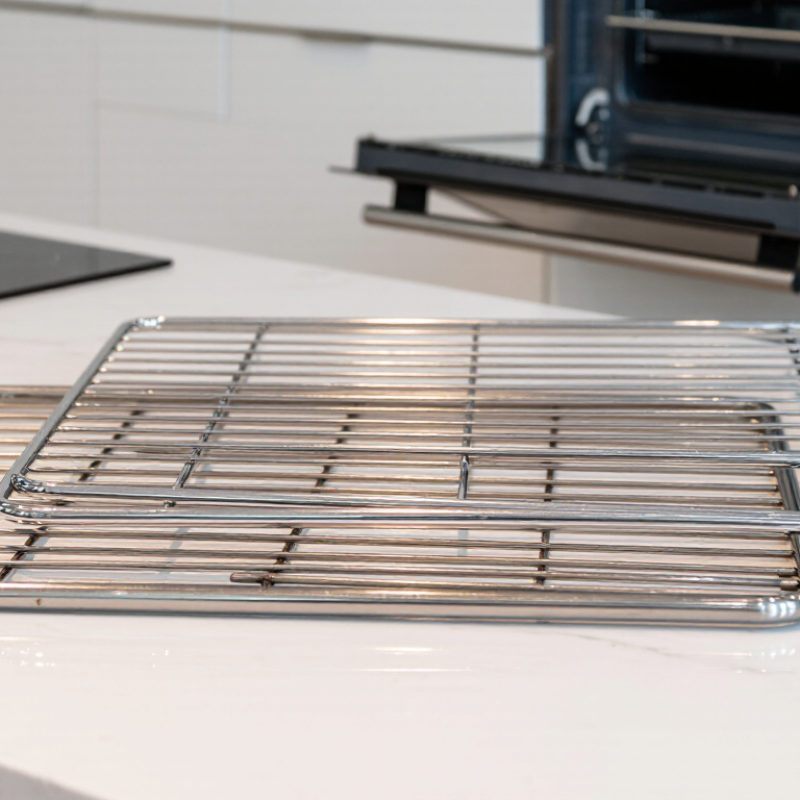
China manufactures several oven rack types, each suited to different cooking needs. Chrome-plated steel racks remain common because they are affordable and easy to clean. However, their surface may discolor after repeated exposure to steam and high heat. Stainless steel racks offer stronger corrosion resistance and suit commercial kitchens or humid environments. They usually cost more, but their service life can justify the difference.
Enameled steel racks provide a smooth, dark surface that resists staining. They work well in household ovens, although chipped enamel can expose the metal underneath. Wire racks with closely spaced bars support small baking dishes better than wide-grid designs. Telescopic racks use sliding rails for safer access, especially when handling heavy roasting trays. Some Chinese manufacturers also produce reinforced racks with thicker wires and welded support points for larger ovens.
From a sourcing perspective, accurate measurements matter more than appearance. Check the rack width, depth, wire diameter, rail movement, and maximum load. A practical inspection should include repeated sliding tests and heat exposure at the intended operating temperature. I once focused too heavily on polished finishing and overlooked rail alignment. That mistake showed me why sample testing should come before bulk production. Ask for material certificates, coating details, weld inspection records, and packaging photographs. Small gaps can cause trays to tilt. Thin wires may bend sooner than expected.
What Is the Best Type of Oven Rack from China?
Key Materials and Construction Features
The best oven rack depends on heat exposure, food contact, load weight, and cleaning conditions. Stainless steel is usually the safest starting point for household and commercial ovens. Grade 304 offers strong corrosion resistance and a clean, food-contact surface. Grade 430 costs less, but it may resist moisture less effectively. Material certificates should support these claims. A polished finish also reduces residue buildup around cooking surfaces.
Construction matters as much as the metal itself. Thick wires handle heavy trays with less bending. Closely spaced crossbars support small dishes and prevent tipping. Welded joints should look even, without sharp points, cracks, or rough splatter. Reinforced side frames improve stability when the rack slides out. Telescopic rails can add comfort, but they need accurate alignment and heat-resistant components.
In factory inspections, I check the rack after repeated heating and cooling cycles. Warping often appears later, not during the first inspection. That detail is easy to miss. Measurements should include wire diameter, rack width, rail clearance, and corner squareness. Load testing should use weight similar to real cookware. I would also question coatings near direct food contact, even when the surface looks attractive. Some buyers focus too heavily on appearance. That is a mistake, although appearance still reveals poor finishing. Supplier audits, traceable test records, and sample approval provide stronger confidence than catalog photos.
The chart compares common oven-rack materials using a practical 1–5 suitability score. Stainless steel generally provides the best balance of corrosion resistance, heat stability, cleanability, and long-term durability. Nickel-plated steel can offer a smooth surface at lower cost, while carbon steel provides strength but requires better protection against oxidation. Scores are comparative material-performance ratings rather than brand specifications.
Choosing the right Chinese oven rack starts with your oven, not the supplier’s catalog. Measure the interior width, depth, and rail spacing carefully. A rack that looks suitable may still scrape the side walls. I have seen this mistake delay kitchen installations.
Stainless steel racks suit humid kitchens and frequent cleaning. Chrome-plated steel can cost less, but its finish may weaken under harsh detergents. For heavy trays, choose thicker wires and reinforced corners. Check the stated load capacity, weld quality, and surface smoothness. Sharp welds are unacceptable. Also consider rack design. Sliding racks offer easier access, while flat racks provide flexible positioning. Airflow matters too. Closely spaced wires can affect baking results, especially with delicate pastries. Ask the Chinese manufacturer for material details, production photos, sample testing, and dimensional drawings. Request a sample before placing a large order. Specifications can look perfect on paper, yet practical fit may disappoint.
Compare at least three samples under the same conditions. Test each rack inside your oven when it is cool. Inspect every weld, coating edge, and corner by hand. Ask whether the rack tolerates your cleaning method and operating temperature. Food-contact safety documentation may also be important for your market. Do not rely only on attractive pricing. A slightly stronger rack often prevents replacement costs later. My own selection process still needs improvement; I once focused too much on appearance and overlooked rail friction. That small detail became annoying during daily use.
Safety begins with fit, not appearance. A reliable oven rack should match the oven’s width, depth, rail spacing, and stop-tab design. Measure the cavity carefully, including the usable space between side supports. A rack that slides smoothly but tips under load is unsafe. Test it with a heavy roasting tray. It should remain level when pulled halfway forward.
Material choice also matters. Stainless steel resists rust and supports repeated heating, while coated steel can offer a lower-cost option. However, coatings must resist flaking, blistering, and food contact heat. Inspect every weld for sharp edges, cracks, or rough residue. Small defects can become serious after many heating cycles. Ask the supplier for material details, dimensional drawings, and thermal-cycle test records.
Quality should be verified, not assumed. Request samples from the same production process used for bulk orders. Check rack deformation after repeated heating and cooling. Confirm that test documents identify the actual material and product model. Applicable food-contact requirements may differ by destination market, so documentation needs careful review. I once treated a polished surface as proof of quality. It was not. A smooth rack can still have weak welds or poor geometry. Independent inspection before shipment adds confidence, especially when measurements vary slightly between batches. Safety is practical, measurable, and sometimes easy to overlook.
The best Chinese oven rack is not always the thickest one. For home baking, coated carbon steel may suit moderate heat and regular cleaning. For commercial kitchens, stainless steel offers better corrosion resistance and easier sanitation. Fit matters more than appearance. Measure the oven cavity, rail spacing, usable depth, and maximum load before contacting suppliers.
When ordering from China, request a physical sample, technical drawing, material grade, wire diameter, and weld photographs. Ask how the supplier controls flatness, corner accuracy, polishing, and coating thickness. A reliable factory should provide batch records and food-contact documentation for the destination market. Do not rely on catalog images. Test the rack at working temperature, then inspect sagging, sharp edges, discoloration, and sliding resistance. A sample may pass visual inspection but fail after repeated loading.
Supplier evaluation also includes communication and packaging. Confirm minimum order quantity, replacement terms, lead time, export packing, and inspection responsibilities in writing. Ask for a small pilot order before scaling production. Cartons need corner protection, separators, and moisture control during ocean transport. Some suppliers promise tight tolerances but measure only after production. That gap deserves attention. Keep approved samples and inspection photos as reference points for every later shipment.
| Rack Type | Common Material | Key Advantages | Main Limitations | Best-Suited Applications | Surface and Cleaning Considerations | Important Order Specifications | Supplier Evaluation Checks |
|---|---|---|---|---|---|---|---|
| 304 Stainless Steel Wire Rack | Austenitic stainless steel, usually 304 grade | Good corrosion resistance, strong construction, clean appearance, and suitable for repeated heating and washing | Higher cost than plated carbon steel; may discolor if exposed to harsh chemicals or salt deposits | Household ovens, bakery ovens, catering equipment, and general foodservice use | Smooth or electropolished surfaces are easier to clean; avoid chloride-based cleaners and abrasive scouring | Steel grade, wire diameter, pitch, overall dimensions, edge shape, load requirement, and welding method | Request material certificates, weld samples, dimensional drawings, load testing, and salt-spray or corrosion data when relevant |
| 316 Stainless Steel Wire Rack | Molybdenum-bearing stainless steel, usually 316 grade | Better resistance to chlorides, salt, and humid environments than 304 stainless steel | More expensive and often unnecessary for dry, standard baking environments | Coastal locations, seafood processing, humid kitchens, and applications with salty residues | Use approved stainless-steel cleaners; rinse thoroughly after exposure to salt or cleaning chemicals | Confirmed 316 chemistry, surface finish, weld passivation, rack geometry, and cleaning environment | Verify the grade with a material report or positive material identification test; inspect weld passivation and surface contamination |
| Chrome-Plated Steel Rack | Low-carbon steel with a nickel and/or chromium decorative coating | Lower initial cost, bright appearance, and adequate rigidity for many standard ovens | Scratches or exposed edges can lead to corrosion; coating quality is critical | Cost-sensitive household appliances and dry indoor applications | Avoid abrasive pads and strong alkaline cleaners; inspect for flaking, blisters, pinholes, and sharp coating edges | Base steel, coating system, coating thickness, adhesion requirement, wire diameter, and edge protection | Check coating adhesion, thickness consistency, corrosion resistance, visual defects, and performance after thermal cycling |
| Aluminized Steel Rack | Steel sheet or wire with an aluminum-silicon coating | Good oxidation resistance and useful performance in many high-heat appliance applications | Coating can be damaged by impact, sharp tools, or aggressive cleaning; appearance may change with use | Oven interiors, baking equipment, and applications requiring economical heat-resistant steel | Use non-abrasive cleaning methods and prevent gouging; exposed steel areas should be monitored for corrosion | Coating type, coating mass or thickness, forming radius, edge condition, heat exposure, and load capacity | Review coating specifications, adhesion, thermal-cycle results, dimensional stability, and edge quality after forming |
| Perforated Sheet Rack | 304 stainless steel, aluminized steel, or coated carbon steel sheet | Provides a stable support surface, reduces small-item fall-through, and can improve heat distribution for some products | Heavier than wire racks and may restrict airflow if the open area is too low | Cookies, small baked goods, trays, packaged products, and items requiring a continuous surface | Perforations must be free of burrs; rounded corners and accessible surfaces simplify washing | Sheet thickness, hole shape and pitch, open-area percentage, flatness, reinforcement, and edge treatment | Measure hole size and open area, check flatness under load, inspect burr removal, and confirm airflow requirements |
| Heavy-Duty Bakery Wire Rack | 304 stainless steel or heat-resistant steel with reinforced frame | High rigidity, strong load support, good airflow, and suitability for repeated commercial use | Higher material and shipping weight; requires accurate welding and frame alignment | Commercial bakeries, convection ovens, roasting operations, and multi-rack production | Continuous welds or well-finished joints reduce residue traps; rack spacing should allow access for cleaning | Maximum distributed load, concentrated-load points, frame profile, wheel or rail interface, and deflection limit | Conduct static-load and deflection tests, verify rail compatibility, inspect weld penetration, and check rack squareness |
| Custom OEM Oven Rack | Material selected according to temperature, corrosion, load, and cost requirements | Can match exact oven geometry, rail spacing, product dimensions, airflow, and installation requirements | Tooling, sampling, engineering changes, and quality control require more time than standard products | Private-label appliances, replacement parts, commercial equipment, and specialized production lines | Specify cleaning chemicals, food-contact requirements, surface roughness, weld finish, and packaging protection | 2D or 3D drawings, tolerances, revision control, inspection plan, packaging method, and approval sample process | Assess engineering capability, prototype accuracy, change-control procedures, traceability, final inspection, and export packaging |