What Is a UV Protection Golf Umbrella?
A UV Protection Golf Umbrella is designed to provide shade from the sun while covering a golfer and their equipment. Its broad canopy can help reduce direct exposure during long rounds, especially on open courses with little tree cover. The term “UV protection” is useful, but it does not tell the whole story. Check the manufacturer’s stated UPF rating, canopy size, and fabric details rather than judging protection by color alone.
Practical design matters, too. A vented canopy may release some wind pressure, while a sturdy frame can feel more dependable in changing weather. The handle should be comfortable to hold, and the umbrella should open smoothly when you need shade between shots. Not magic. Sunlight can reach skin from the sides, and conditions change with the time of day, cloud cover, and course surroundings. For that reason, an umbrella works best as one part of sensible sun protection, alongside clothing, sunscreen, and breaks in the shade. Even a premium model can feel awkward if it is too heavy or difficult to carry. That trade-off is easy to overlook. This guide explains how UV golf umbrellas work, which features deserve attention, and how to choose one for your course, climate, and playing habits. It also separates useful specifications from marketing claims, so you can make a more informed choice.
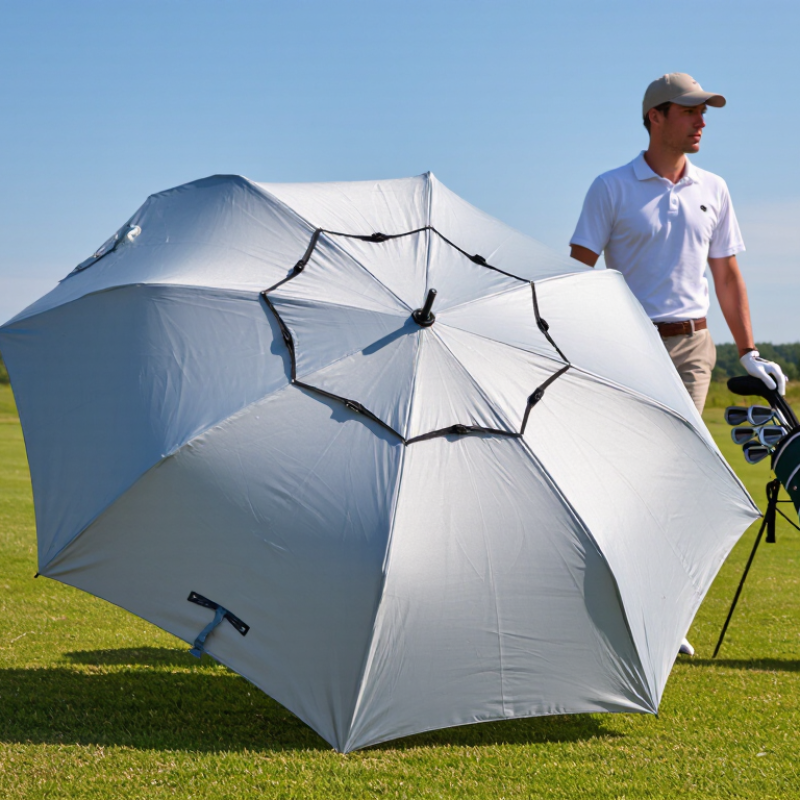
What Defines a UV Protection Golf Umbrella?
A UV protection golf umbrella is defined by its tested canopy fabric, not simply its size or color. Look for a stated UPF rating and testing details. Under the Australian Radiation Protection and Nuclear Safety Agency’s UPF guidance, UPF 50+ fabric transmits about 2% or less of the UV radiation used in testing. That is a useful benchmark, not a promise of complete protection in every situation. Small distinction, big value.
Canopy coverage matters on the course. A broad canopy can shade your face, neck, and shoulders, but sunlight can still reach you from the sides or reflect off nearby surfaces. The World Health Organization’s Global Solar UV Index guide recommends protective measures when the UV Index reaches 3 or higher. Check the day’s UV Index, especially during long rounds. Practical details count: a secure grip, a canopy that stays open in a breeze, and enough room to shade your upper body. Fabric condition matters too; stretched, damaged, or poorly tested material may not perform as expected. Labels can be confusing. I would treat a clear UPF rating and a named test method as stronger evidence than a vague “UV-resistant” claim.
How Its Canopy Blocks Ultraviolet Radiation
A UV protection golf umbrella works by placing a dense canopy between your skin and direct sunlight. Its fabric absorbs and reflects ultraviolet rays, reducing how much reaches your face, neck, and arms. Some canopies use tightly woven cloth or UV-absorbing coatings; performance depends on material, color, stretch, and wear. A dark canopy may feel cooler only if its surface also limits heat buildup. Small details matter.
The Australian Radiation Protection and Nuclear Safety Agency explains that UPF 50 fabric transmits about 1/50 of UV radiation under test conditions, blocking roughly 98%. That figure applies to tested fabric, not automatically to every umbrella. Ask whether the canopy itself was tested. The World Health Organization advises sun protection when the UV Index reaches 3 or higher. Shade helps. It is not complete protection. UV can scatter from pavement, water, and sand, while sunlight may reach exposed skin from the sides. I have found the handle angle matters on a windy course; a small shift can uncover one shoulder. Use sunscreen and protective clothing too, especially during long rounds.
Materials and Design Features That Affect UV Protection
A UV protection golf umbrella depends on more than its size. The canopy fabric is the first detail to inspect. Tightly woven polyester or nylon can reduce sunlight passing through, while a tested UV rating offers clearer guidance than fabric color alone. Dark cloth may feel cooler underneath, but color by itself does not prove protection.
Some canopies use a coating or an extra inner layer to block more ultraviolet radiation. These layers can add weight, and coatings may wear with repeated folding, rain, and storage. Check whether the product lists a UPF rating and how that rating was measured.
I used to assume a shiny underside meant stronger protection. That is not a reliable rule.
Coverage matters, too. A broad canopy can shade the shoulders and face, but angled sun still reaches exposed skin. Look for a deep canopy, sturdy ribs that hold its shape, and a handle comfortable enough for long rounds. Small gaps near seams or stretched fabric can change how much light gets through.
Not perfect.
An umbrella also cannot block every reflection from grass, sand, or nearby water, so uncovered areas still need attention.
How to Choose a UV Protection Golf Umbrella
What Is a UV Protection Golf Umbrella?
How to Choose a UV Protection Golf Umbrella
A UV protection golf umbrella is designed to block some ultraviolet radiation while providing broad shade on the course. Its canopy may use tightly woven fabric or a UV-reflective coating. Check the product’s stated UPF rating and how it was tested; a high rating offers useful information, not total protection. Sunlight can still reach you from nearby surfaces.
Choose a canopy wide enough to shade your head, shoulders, and golf bag without making the umbrella awkward to carry. A larger canopy can catch more wind, so look for a vented design and sturdy, flexible ribs. Compare the open size with your golf cart or storage space. Check the handle, too. A comfortable grip matters during a long round, though it is easy to overlook in product photos. Color and coating may affect heat and glare, but don’t assume appearance alone proves UV performance.
Tips: Look for clear UPF details, a secure opening mechanism, and a canopy that feels manageable in a light breeze. Test the handle if possible. I once focused too much on size; carrying an unwieldy umbrella got old quickly. No umbrella blocks every ray, so use other sun protection as well.
Care, Use, and Limits of Umbrella-Based Sun Protection
A UV-protection golf umbrella works best as movable shade, not a complete sun shield. Look for a tested UPF rating: UPF 50+ fabric transmits no more than 1/50 of UV radiation under test conditions. That is about 98% blocked. WHO and World Meteorological Organization guidance recommends sun protection when the UV Index reaches 3 or higher. Angles matter. Keep the canopy between your skin and the sun, and remember that your face, hands, and legs may still catch direct or reflected UV. A breeze can shift the shade in seconds.
Care affects performance. Let the umbrella dry fully before folding it, and check for worn coating, torn fabric, or gaps near seams. Don’t assume a dark canopy or large diameter guarantees protection; coverage changes as the sun moves. A 2017 randomized trial published in JAMA Dermatology found sunburn after 3.5 hours in 78% of participants using a beach umbrella, compared with 25% using SPF 100 sunscreen. Beach conditions differ from a golf course, but the finding shows shade alone can fall short. That is easy to forget. Combine shade with clothing, sunglasses, and sunscreen on exposed skin, then reapply sunscreen as directed.
What Is a UV Protection Golf Umbrella?
How a fabric’s UPF rating relates to the share of UV radiation it blocks
How to read this chart: UPF describes UV transmission through fabric. The percentages are calculated from the ratings: UPF 15 blocks about 93.3%, UPF 30 about 96.7%, and UPF 50+ at least 98%. An umbrella’s real-world protection also depends on its coverage, angle, fabric condition, and UV reaching you from the sides or reflected surfaces. Use sunscreen and protective clothing as well.

